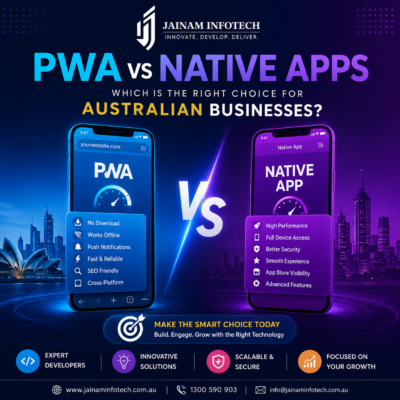
PWA vs Native Apps: Which is the Right Choice for Australian Businesses?
Mobile users today expect fast, seamless, and engaging digital experiences. Whether they are shopping online, booking services, or managing business operations, they want everything to work instantly on their smartphones. This is why many Australian businesses face an important question before investing in mobile technology: Should you build a Progressive Web App (PWA) or a Native App? The answer depends on your business objectives, customer expectations, budget, and long-term growth plans. Both technologies offer unique advantages, but selecting the wrong one can increase costs while limiting customer engagement. In this guide, we’ll explain the differences between PWAs and Native Apps, compare their strengths, and help you determine which solution best fits your business. If you’re planning to build a high-performing mobile application, Jainam Infotech can help you choose the right technology and develop a scalable solution tailored to your business goals. What is a Progressive Web App (PWA)? A Progressive Web App combines the accessibility of a website with many features of a mobile application. Users can access it directly through their browser without downloading it from the App Store or Google Play. Modern PWAs offer: Since a single codebase works across multiple devices, PWAs are often a cost-effective solution for businesses looking to launch quickly while maintaining a consistent user experience. Properly optimized PWAs can also improve search visibility because search engines can index their content. What is a Native App? A Native App is developed specifically for one operating system, such as Android or iOS. These applications are downloaded through official app stores and are designed using platform-specific programming languages. Native applications provide: Businesses that require advanced mobile capabilities often choose native development because it delivers maximum performance and reliability. PWA vs Native Apps: Key Comparison Development Cost PWAs generally require less investment because one application works across multiple platforms. Native Apps require separate development for Android and iOS, increasing development and maintenance costs. Best Choice: PWA for businesses with limited budgets. User Experience Native Apps provide smoother navigation, faster interactions, and better performance for complex features. PWAs continue improving every year but may still have limitations for highly interactive applications. Best Choice: Native App for premium user experience. Performance Native Apps are optimized for the operating system, making them significantly faster for graphics-intensive applications, real-time processing, and advanced functionality. PWAs perform well for most business websites and service applications but cannot always match native speed for resource-heavy tasks. Installation PWAs require no app store download. Users simply visit your website and can install it from their browser. Native Apps require installation from Google Play or the Apple App Store. Businesses wanting fewer barriers to customer acquisition often prefer PWAs. SEO Benefits This is where PWAs have a major advantage. Since PWAs are web-based, search engines can crawl and index their pages, helping businesses generate organic traffic through Google Search. Native Apps rely mainly on App Store Optimization (ASO) rather than traditional SEO. Offline Access Both solutions support offline functionality. Native Apps provide more complete offline capabilities, while PWAs can cache selected content for offline use using service workers. Maintenance PWAs are easier to maintain because updates are deployed instantly. Native Apps require users to download updates through app stores. Which Solution is Better for Australian Businesses? There isn’t a single answer for every business. Choose a Progressive Web App if you: Choose a Native App if you: Many Australian businesses begin with a PWA to validate their market before investing in Native Apps as their customer base grows. Industries That Benefit Most from PWAs PWAs are ideal for: Their ability to load quickly, improve mobile usability, and support SEO makes them an excellent choice for businesses focused on online lead generation. Industries That Benefit Most from Native Apps Native Apps are better suited for: These industries depend on device integration and high-performance mobile experiences. How Jainam Infotech Helps Australian Businesses Selecting between a PWA and a Native App involves more than comparing features. Your decision should align with your business model, customer behavior, growth strategy, and future scalability. At Jainam Infotech, we help Australian businesses build mobile solutions that deliver measurable business outcomes. Our experienced development team evaluates your project requirements before recommending the most suitable technology. Our services include: Every solution is developed with a strong focus on speed, security, scalability, and user experience to maximize customer engagement and business growth. Final Thoughts Both PWAs and Native Apps offer significant advantages, but choosing the right one depends on your specific business goals rather than following market trends. If your priority is affordability, faster deployment, SEO visibility, and cross-platform accessibility, a Progressive Web App can deliver exceptional value. If your business demands premium performance, advanced device integration, and a highly interactive mobile experience, investing in a Native App is the smarter long-term decision. Before making your investment, consult experienced mobile application experts who understand both technologies. Jainam Infotech works closely with Australian businesses to build reliable, scalable, and future-ready mobile applications that enhance customer engagement, strengthen digital presence, and support long-term business success.
Read More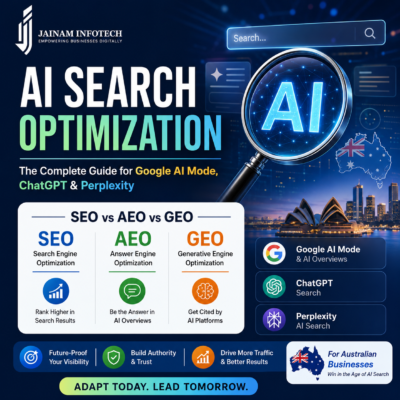
AI Search Optimization Guide for Australia: SEO vs AEO vs GEO for Google AI Mode, ChatGPT & Perplexity | Jainam Infotech
Artificial intelligence is changing how people search online. Traditional search engine optimization is no longer the only strategy businesses need to focus on. Today, users are finding answers through Google AI Mode, AI Overviews, ChatGPT, Perplexity, and other AI-powered search experiences. This shift is creating new opportunities for businesses that understand how AI search works. For Australian businesses looking to increase online visibility, mastering AI Search Optimization has become essential. Companies that adapt early can gain a competitive advantage by appearing in AI-generated answers, citations, and recommendations before their competitors. In this guide, Jainam Infotech explains the differences between SEO, AEO, and GEO, along with practical strategies to help businesses improve visibility across Google AI Mode, ChatGPT, Perplexity, and other emerging AI search platforms. What Is AI Search Optimization? AI Search Optimization is the process of optimizing your website and content so that artificial intelligence-powered search engines can easily understand, trust, and recommend your information. Unlike traditional search engines that primarily display a list of websites, AI-powered search platforms analyze information from multiple sources and generate direct answers for users. As a result, businesses need to optimize their content not only for rankings but also for AI citations and recommendations. For Australian businesses, AI Search Optimization helps improve visibility across: Understanding SEO, AEO, and GEO SEO (Search Engine Optimization) SEO focuses on improving website visibility in traditional search engine results. The primary goal is to increase organic rankings for relevant keywords and drive qualified traffic to your website. Key SEO activities include: SEO remains important because traditional search results still generate significant traffic across Australia and global markets. AEO (Answer Engine Optimization) AEO (Answer Engine Optimization) focuses on helping your content become the direct answer users receive from search engines and AI assistants. Instead of simply ranking on page one, the goal is to provide concise, accurate, and trustworthy answers that AI systems can extract and display. AEO strategies include: As AI-generated answers become more common, AEO is becoming a critical part of digital marketing. GEO (Generative Engine Optimization) GEO (Generative Engine Optimization) focuses specifically on improving visibility within generative AI platforms such as ChatGPT, Perplexity, and Google’s AI-powered search experiences. GEO helps AI systems understand your expertise and use your content as a trusted source when generating responses. Effective GEO strategies include: For businesses targeting future search trends, GEO is quickly becoming a core component of AI Search Engine Optimization. Why Australian Businesses Need AI Search Optimization Australia has one of the highest internet adoption rates globally, and AI-powered search tools are rapidly influencing consumer behavior. Users are increasingly asking AI tools questions such as: If your website is not optimized for AI search experiences, competitors may receive the visibility and traffic that could have been yours. Businesses that invest in AI Search Optimization today are positioning themselves for long-term growth as AI search adoption continues to increase. How Google AI Mode Is Changing Search Google AI Mode SEO is becoming a priority because Google is moving beyond traditional search listings. Instead of displaying ten blue links, Google AI Mode generates detailed responses using information collected from multiple trusted sources. To improve visibility in AI-powered results, businesses should: Content that demonstrates expertise and answers user questions clearly is more likely to appear within AI-generated responses. Google AI Overviews Optimization Best Practices Google AI Overviews Optimization focuses on helping content appear within AI-generated summaries displayed at the top of search results. Some proven strategies include: Create Comprehensive Content Cover topics in depth while maintaining readability. Answer Questions Clearly Provide direct answers near the beginning of each section. Use Structured Headings Organized content helps AI systems understand context more effectively. Demonstrate Expertise Include real insights, industry experience, and practical recommendations. Keep Information Updated Fresh content is more likely to be referenced by AI systems. ChatGPT SEO Strategies for Better Visibility ChatGPT SEO involves creating content that AI models can understand, trust, and reference. Businesses should focus on: Building Topic Authority Create multiple pieces of content around your primary service areas. Publishing Original Insights Unique research and expert opinions increase trustworthiness. Maintaining Content Accuracy AI systems prioritize reliable and factual information. Strengthening Brand Mentions Consistent brand visibility across trusted websites improves credibility. For Australian businesses, establishing authority within a specific niche can significantly improve AI-driven visibility. Perplexity SEO Strategies Perplexity SEO differs slightly because Perplexity frequently cites sources directly within its responses. To improve visibility: Perplexity often rewards content that provides clear explanations and actionable advice. Practical AI Search Optimization Strategies for 2026 Businesses looking to succeed in AI-powered search should focus on the following: Develop Topical Authority Cover all aspects of your industry through interconnected content. Strengthen E-E-A-T Signals Demonstrate Experience, Expertise, Authoritativeness, and Trustworthiness. Improve Technical SEO Fast-loading websites remain important for both traditional and AI search. Use Structured Data Schema markup helps AI systems understand content context. Create Human-Centered Content Content should solve real problems rather than simply target keywords. Earn High-Quality Backlinks Authority signals remain valuable across SEO, AEO, and GEO. Optimize Local Presence Australian businesses should maintain accurate local listings and location-focused content. How Jainam Infotech Helps Businesses Succeed in AI Search As AI search continues to evolve, businesses need a modern optimization strategy that goes beyond traditional SEO. Jainam Infotech helps businesses improve visibility across Google search, AI-powered search platforms, and emerging generative engines. By combining SEO, AEO, and GEO strategies, businesses can strengthen online authority, increase qualified traffic, and improve their chances of appearing in AI-generated responses. Whether you want to improve rankings, increase citations in AI search results, or build long-term digital authority, a comprehensive AI Search Optimization strategy is now essential for sustainable growth. Businesses looking to stay ahead of competitors can explore professional SEO services and build a stronger foundation for future search experiences. Final Thoughts The future of search is no longer limited to traditional SEO. Businesses must now optimize for search engines, answer engines, and generative AI platforms simultaneously. SEO drives visibility in traditional search results. AEO helps content become the answer. GEO increases the likelihood of being cited by AI-powered
Read More