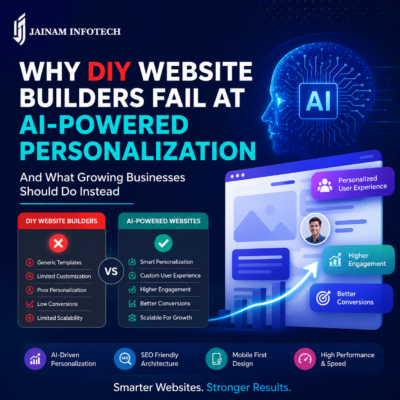
Why DIY Website Builders Fail at AI-Powered Personalization (And What Growing Businesses Should Do Instead)
Building a website has never been easier. With countless DIY website builders available today, many businesses believe they can create a professional online presence without hiring a web development company. While these platforms make website creation simple, they often fail to support one of the most important factors influencing online success today: AI-powered personalization. Modern customers expect websites to understand their interests, display relevant content, recommend suitable services, and provide a smooth browsing experience. Unfortunately, most drag-and-drop website builders cannot deliver these personalized experiences. As a result, businesses often experience lower engagement, fewer enquiries, and missed sales opportunities. If your website receives visitors but struggles to convert them into customers, the issue may not be your marketing strategy. Instead, your website may lack the intelligence needed to create meaningful interactions with every visitor. In this guide, you’ll learn why DIY website builders fall short, how AI-powered personalization improves customer experience, and why businesses choose Jainam Infotech for scalable, SEO-friendly website development solutions. What Is AI-Powered Personalization? AI-powered personalization uses artificial intelligence to customize website experiences according to each visitor’s behaviour, interests, browsing history, device, location, and search intent. Rather than presenting identical content to everyone, AI helps websites display information that is more relevant to individual users. This improves user experience while increasing engagement and conversion opportunities. Some common examples include: Businesses that invest in AI website personalization often notice improvements in customer satisfaction because users quickly find information relevant to their needs. Why Customers Expect Personalized Experiences Today’s online users have become accustomed to personalized recommendations across search engines, eCommerce websites, streaming platforms, and social media. Naturally, they expect business websites to provide the same level of convenience. When visitors immediately find relevant services, useful information, and clear solutions to their problems, they are more likely to stay longer and contact the business. On the other hand, websites displaying generic content to every visitor often struggle with high bounce rates because users cannot quickly identify whether the business meets their requirements. Why DIY Website Builders Fall Behind DIY website builders are designed primarily for simplicity and affordability. Although they offer attractive templates and drag-and-drop editors, they usually lack the flexibility required for advanced AI-powered personalization. Businesses planning long-term digital growth often outgrow these platforms because customization options become increasingly limited. Limited Customer Data Integration AI personalization depends on collecting and analysing data from multiple sources such as CRM software, enquiry forms, marketing platforms, analytics tools, and customer interactions. Most DIY website builders provide only basic visitor statistics, making it difficult to build personalized user journeys or intelligent recommendations. Without comprehensive customer data, AI cannot accurately predict user preferences or deliver relevant content. Generic Website Templates Template-based websites often follow similar layouts, navigation structures, and content blocks. While they look visually appealing, they rarely provide experiences tailored to individual visitors. Every visitor sees the same homepage, the same service descriptions, and the same calls-to-action regardless of their interests or browsing behaviour. This one-size-fits-all approach reduces engagement because different users have different goals when visiting your website. Restricted AI Integrations Modern businesses frequently use AI chatbots, predictive search, intelligent lead qualification, recommendation engines, marketing automation, and customer behaviour tracking. Many DIY platforms either do not support these integrations or offer only limited functionality through third-party plugins. This restricts businesses from building advanced customer journeys that improve conversions. Limited SEO Flexibility Search engine optimization involves much more than adding keywords to a webpage. Successful SEO requires: Many DIY website builders offer only basic SEO settings, limiting long-term organic visibility and reducing opportunities to compete against established businesses. Performance Limitations Website speed plays a significant role in both search rankings and user experience. Heavy themes, unnecessary scripts, and restricted hosting environments often slow down DIY websites. Even a small delay in loading important pages can increase bounce rates and reduce conversions. Businesses investing in custom website development can optimize every aspect of performance, resulting in faster page loading, smoother navigation, and better customer experiences. Why Custom Website Development Makes a Difference A professionally developed website is designed around your business objectives rather than template limitations. Instead of forcing your business into predefined layouts, custom website development provides complete flexibility for AI integrations, SEO improvements, conversion optimization, and future scalability. This enables businesses to create websites that continuously improve as customer expectations evolve. How Poor Personalization Hurts Your Business Many businesses assume that generating website traffic is enough to increase enquiries and sales. However, attracting visitors is only the first step. If your website fails to deliver a relevant and engaging experience, potential customers are likely to leave without taking any action. When every visitor is shown the same content, the same offers, and the same call-to-action, your website misses valuable opportunities to connect with users based on their specific interests. AI-powered personalization helps solve this challenge by presenting relevant information that aligns with each visitor’s needs. A lack of personalization can negatively impact several important business metrics, including: Customers appreciate websites that make it easy to find answers quickly. The more relevant your content is, the more likely visitors are to stay, explore additional pages, and contact your business. Signs Your Website Has Outgrown a DIY Builder If your business is expanding, your website should support that growth rather than limit it. Many companies begin with a DIY website builder but eventually discover that it cannot keep up with changing customer expectations and digital marketing requirements. Your website may need a professional upgrade if you notice any of the following: These challenges often indicate that your website platform is restricting your growth rather than supporting your long-term business goals. Benefits of an AI-Ready Custom Website A custom-built website offers significantly greater flexibility than template-based platforms. It allows businesses to integrate intelligent technologies that improve customer experience while increasing marketing performance. Some of the biggest advantages include: Unlike DIY platforms, custom websites give businesses complete control over design, functionality, performance, and user experience. This creates stronger engagement and encourages visitors to move further through the buying
Read More
How Brands in India Are Using Generative AI to Scale Social Content
The last few years have witnessed an astonishing transformation in how brands manage and expand their social media presence. What was once a manual, time-intensive process has now become a sophisticated, technology-driven operation—thanks to generative AI marketing. Brands in India are pioneering a wave of innovation, leveraging advanced algorithms to create, curate, and scale compelling social content at unprecedented speeds. As Australian businesses look to lead in their own markets, the strategies and lessons coming from India serve as an invaluable roadmap for anyone aiming to supercharge their AI social media marketing game. This blog explores how Indian brands deploy generative AI tools, the trends reshaping content creation, and actionable strategies that Australian marketers can adapt to stand out in 2025. The Rapid Rise of Generative AI Marketing Within just a few years, generative AI marketing has evolved from experimental deployments to a must-have capability for digital-first brands. In India, where digital audiences are enormous and diverse, brands recognized early the value of automating repetitive tasks without compromising on creativity. Generative AI tools can now automatically produce images, videos, captions, and even multi-platform campaigns—often tailored down to hyper-specific audience segments. This technology efficiently addresses two of the greatest challenges in AI social media marketing: the need for scale and the demand for personalization. Why Indian Brands Lead the Change India’s social ecosystem is vast and uniquely fragmented across languages, cultures, and content preferences. Indian marketers quickly realized that manual workflows couldn’t keep up. By shifting to generative AI marketing solutions, they’ve been able to: Such strategic advances are reshaping the meaning of agility and responsiveness for global audiences. Key Ways Indian Brands Are Leveraging Generative AI Automated Content Ideation and Creation Content ideation, once the domain of lengthy brainstorming sessions, is now supercharged by AI models. Advanced systems scan trending topics, hashtags, past campaign performance, and global news to suggest timely ideas for posts, captions, and visuals. For brands, this means never running out of fresh concepts that resonate with local and global audiences. Multi-Format, Multi-Language Content Generation Indian brands often serve audiences speaking 10 or more languages. Generative AI marketing platforms seamlessly produce banners, videos, and text in multiple languages, ensuring broad engagement without the overhead of large creative teams. Automation also includes adaptation for different channels—what works on Instagram Stories may not work on LinkedIn, so AI tailors content formats and messaging accordingly. Personalization at Scale One of the most significant benefits of AI social media marketing is the ability to craft highly personalized experiences. Using AI, Indian brands segment their audiences not just by demographics but by behavior, preferences, and real-time engagement signals. The output? Bespoke content journeys that increase relevance, satisfaction, and conversion. Predictive Publishing Timing is everything in social media. With generative AI, brands analyze historical campaign data, audience engagement trends, and even seasonality to predict optimal posting times and formats. The result is a marked improvement in reach, engagement, and ROI for every post. Real-World Examples of Generative AI Marketing FMCG & Retail Large consumer brands automate social campaigns for product launches, local festivals, and offers. For example, an FMCG giant may release a multi-lingual Diwali campaign across different regions, with AI generating visuals, copy, and targeting strategies for each market segment. E-commerce Online retailers use AI-powered platforms to create localized ad creatives, suggest products based on user data, and A/B test thousands of ad copies for the highest-converting combination—all at a speed impossible with manual methods. Entertainment Media companies and streaming services rely on AI to script, edit, and distribute short-form video content, auto-generate subtitles in different Indian languages, and personalize show recommendations using generative models. Service Providers From fintech to health tech, AI social media marketing delivers targeted educational content and customer support, utilizing chatbots to answer common questions and engage audiences 24/7. Key Changes and Additions Driven by Generative AI Goodbye Manual, Hello Automation The adoption of generative AI in marketing marks a shift away from tedious, manual workflows. Content calendars, ideation, asset selection, and even A/B testing are now automated, freeing up creative teams for more strategic tasks. Sentiment Analysis and Adaptation Advanced AI tools perform real-time sentiment analysis, tracking how audiences react to campaigns. This immediate feedback loop lets brands tweak messaging, visuals, and offers to maximize positive engagement and reduce risks. Granular Audience Insights AI-driven analytics break down campaign results by region, language, age group, and even interests, providing a 360-degree view of what works and what doesn’t. Marketers can double down on successful formulas and quickly pivot when needed. Enhanced Collaboration AI-powered platforms now allow simultaneous collaboration across teams, regions, and time zones. Creative inputs, approval workflows, and live upgrades streamline the entire content lifecycle, ensuring brand consistency. Adapting Indian Strategies for Australia’s Unique Market Australian businesses face their own challenges—an increasingly multicultural audience, rapid digital adoption, and high expectations for brand responsiveness. Adopting generative AI marketing strategies pioneered in India can help Australian brands: 2025 Trends: The Future of AI Social Media Marketing As 2025 progresses, the convergence of AI trends signals even greater possibilities for brands: Trending FAQs on Generative AI Marketing and AI Social Media Marketing Q1: How does generative AI marketing improve social media campaigns?Generative AI marketing helps brands consistently produce, optimize, and personalize content at scale. By automating everything from ideation to analytics, it drives faster engagement and boosts campaign performance. Q2: Which industries in India are leading in AI social media marketing?Industries like FMCG, retail, entertainment, and e-commerce are at the forefront, using AI to automate creatives, target new segments, and manage massive content volumes on social platforms. Q3: Is generative AI marketing cost-effective for Australian brands?Absolutely. By cutting down manual workloads, minimizing creative bottlenecks, and optimizing ad spend with AI-driven predictions, Australian brands see significant improvements in ROI and social performance. Q4: Are there privacy concerns with AI social media marketing?Yes. Leading brands ensure AI tools comply with privacy regulations, protecting audience data while still tailoring content for engagement and conversion. Q5: Can small businesses
Read More