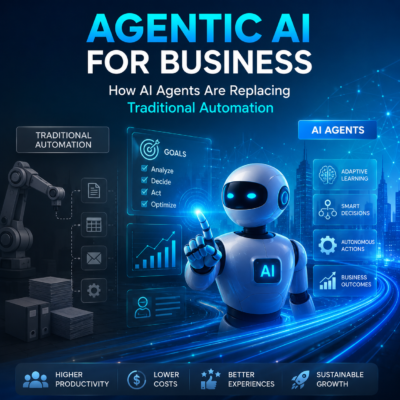
Businesses across Australia are entering a new era of digital transformation. For years, traditional automation tools helped organizations reduce manual work, improve efficiency, and streamline repetitive processes. However, the rapid evolution of artificial intelligence has introduced a more advanced approach: Agentic AI.
Today, companies are no longer looking for systems that simply follow predefined rules. They want intelligent solutions that can understand goals, make decisions, adapt to changing situations, and execute complex tasks independently. This is where Agentic AI for Business: How AI Agents Are Replacing Traditional Automation becomes one of the most important conversations in the technology landscape.
At Jainam Infotech, we help Australian businesses stay ahead of digital trends through strategic SEO and technology-focused marketing solutions. As AI continues reshaping industries, understanding the difference between traditional automation and AI agents is becoming essential for sustainable growth.
What Is Agentic AI?
Agentic AI refers to intelligent AI systems that can perceive information, reason through problems, make decisions, and take actions to achieve specific objectives with minimal human intervention.
Unlike conventional automation software, which follows fixed workflows and rules, AI agents can:
- Analyze context
- Learn from interactions
- Adapt to changing environments
- Coordinate multiple tasks
- Make autonomous decisions
- Interact with different software systems
Enterprise AI agents Jainam Infotech combine large language models, machine learning, reasoning capabilities, and tool integrations to execute business processes more intelligently than traditional automation systems. (IBM)
This shift is transforming how organizations operate, from customer service and marketing to finance, operations, and human resources.
Traditional Automation vs Agentic AI
Traditional automation has delivered significant value over the past decade. Robotic Process Automation (RPA), workflow automation, and scripted systems have helped businesses automate repetitive tasks.
However, traditional automation comes with limitations.
Traditional Automation
- Follows predefined rules
- Works best with structured data
- Requires manual updates when processes change
- Limited decision-making capabilities
- Struggles with unexpected situations
Agentic AI
- Understands business objectives
- Makes context-aware decisions
- Learns from outcomes
- Handles unstructured data
- Adapts to changing business conditions
- Coordinates multiple systems autonomously
The difference is simple. Traditional automation follows instructions. Agentic AI pursues outcomes.
This evolution allows businesses to automate not only repetitive tasks but also complex workflows that previously required human judgment.
Why Australian Businesses Are Embracing AI Agents
Australia has become one of the fastest-growing markets for AI adoption. Research indicates that Australian organizations are increasingly moving beyond experimentation and integrating AI across multiple business functions.
Several factors are driving this trend:
Rising Operational Costs
Businesses across Australia face increasing pressure to improve productivity while controlling costs. AI agents can operate continuously, reduce manual workloads, and improve operational efficiency.
Demand for Faster Decision-Making
Modern businesses generate enormous amounts of data. AI agents can analyze information in real time and make recommendations or decisions faster than traditional systems.
Customer Experience Expectations
Consumers now expect instant responses, personalized interactions, and seamless service. AI agents help businesses deliver these experiences at scale.
Competitive Advantage
Organizations adopting agentic AI are positioning themselves ahead of competitors by improving speed, accuracy, and responsiveness across departments.
Recent industry findings show growing investment and adoption of agentic AI across Australian enterprises as businesses seek productivity gains and automation at scale.
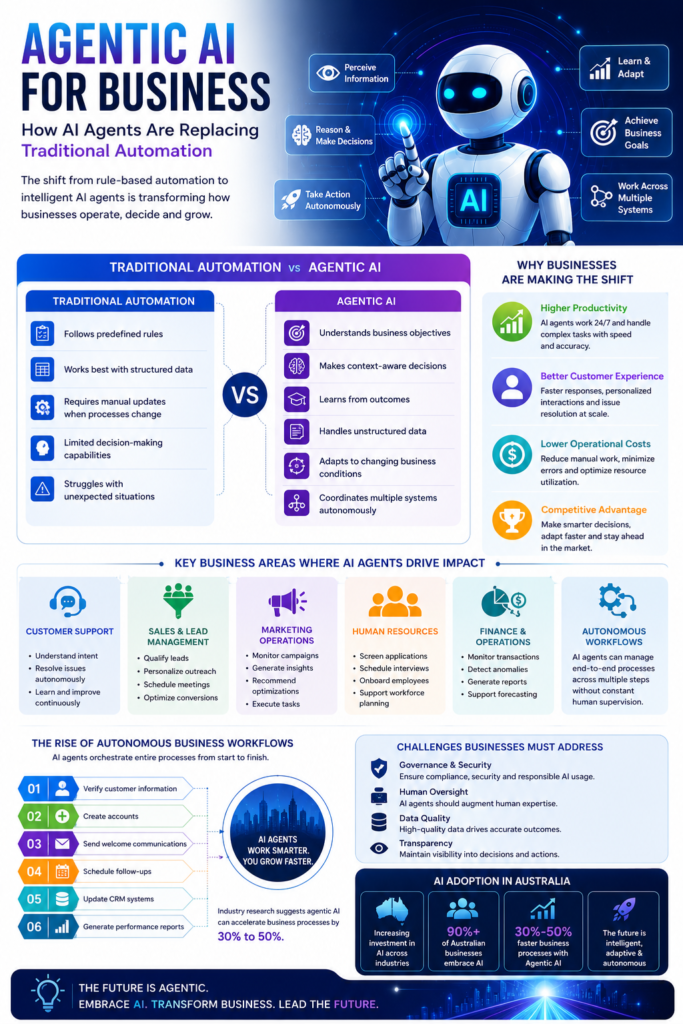
Key Business Areas Where AI Agents Are Replacing Traditional Automation
Customer Support
Traditional chatbots follow scripted responses and often struggle with complex customer queries.
AI agents can:
- Understand customer intent
- Access knowledge bases
- Resolve issues autonomously
- Escalate when necessary
- Learn from previous interactions
This leads to faster resolutions and higher customer satisfaction.
Sales and Lead Management
SEO AI agents can analyze customer behavior, qualify leads, schedule meetings, and personalize outreach campaigns.
Instead of relying on static workflows, they continuously optimize interactions based on performance data.
Marketing Operations
Modern marketing requires data analysis, campaign management, content generation, and customer segmentation.
AI agents can:
- Monitor campaign performance
- Identify opportunities
- Generate insights
- Recommend optimizations
- Execute marketing tasks automatically
For businesses investing in digital growth, this creates a major competitive advantage.
Human Resources
AI agents are helping HR teams:
- Screen applications
- Schedule interviews
- Answer employee questions
- Manage onboarding processes
- Support workforce planning
This reduces administrative burden and improves employee experiences.
Finance and Operations
AI agents can monitor financial transactions, identify anomalies, generate reports, and support forecasting activities.
Unlike traditional automation systems, they can adapt to changing business conditions and evolving datasets.
The Rise of Autonomous Business Workflows
One of the most significant developments in agentic AI is workflow orchestration.
Instead of automating isolated tasks, AI agents can manage entire processes.
For example, an AI agent handling customer onboarding can:
- Verify customer information
- Create accounts
- Send welcome communications
- Schedule follow-ups
- Update CRM systems
- Generate performance reports
All of these actions can occur without constant human supervision.
Industry research suggests agentic AI can accelerate business processes by 30% to 50% while reducing time spent on repetitive work.
Challenges Businesses Must Address
While the opportunities are significant, successful implementation requires careful planning.
Governance and Security
Businesses must ensure AI agents operate within defined rules and compliance frameworks.
Human Oversight
AI agents should augment human expertise rather than completely replace human judgment.
Data Quality
The effectiveness of AI agents depends heavily on the quality of the data they access.
Transparency
Organizations need visibility into how AI agents make decisions and execute actions.
Studies show trust, governance, and control remain among the biggest barriers to broader AI adoption across Australian businesses.
What This Means for SEO and Digital Growth
The rise of AI in Jainam Infotech is not only transforming operations but also changing how businesses attract customers online.
As search engines evolve, businesses need stronger digital visibility, authoritative content, and strategic SEO to remain competitive.
Companies that embrace AI while maintaining strong search engine optimization strategies will be better positioned to capture high-intent traffic and generate qualified leads.
This is where Jainam Infotech helps Australian businesses succeed.
Through advanced SEO strategies, technical optimization, content marketing, and data-driven digital solutions, Jainam Infotech supports organizations looking to improve online visibility and drive sustainable growth in increasingly competitive markets.
Businesses seeking professional SEO support can explore the dedicated Australia-focused SEO services offered by Jainam Infotech at https://jainaminfotech.com/seo-services-australia/.
The Future of Agentic AI in Australia
The future of business automation is moving beyond rules-based systems toward intelligent, goal-driven agents.
Australian organizations are already investing heavily in AI technologies that can adapt, reason, and execute complex workflows. As adoption accelerates, businesses that fail to embrace this shift risk falling behind competitors that operate with greater efficiency and agility.
However, the most successful organizations will not simply replace people with AI. Instead, they will combine human expertise with intelligent AI agents to create faster, smarter, and more scalable operations.
Conclusion
The shift from traditional automation to agentic AI represents one of the most significant technological transformations of the decade. Unlike conventional systems that follow predefined instructions, AI agents can understand objectives, make decisions, learn from outcomes, and adapt to changing business environments.
For Australian businesses, the opportunity is clear. Organizations that adopt intelligent AI agents can improve productivity, enhance customer experiences, reduce operational costs, and gain a sustainable competitive advantage.
As the conversation around Agentic AI for Business: How AI Agents Are Replacing Traditional Automation continues to grow, companies must also ensure they maintain a strong digital presence. With expert SEO solutions, strategic content marketing, and performance-driven digital strategies, Jainam Infotech helps businesses across Australia build visibility, authority, and long-term online success.