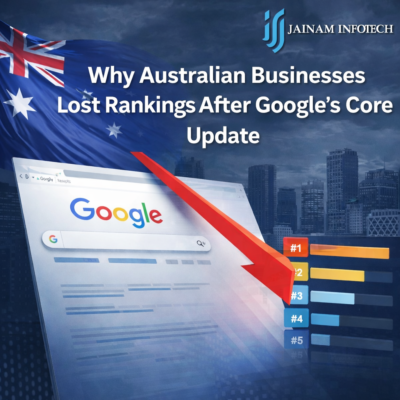
Why Australian Businesses Lost Rankings After Google’s Core Update 2026
This guide explains how service business SEO has changed for Australian companies after the Google Core Update. Australian service businesses have felt the impact of recent Google Core Updates more sharply than many other markets. Across industries such as plumbing, electrical services, healthcare, legal firms, accounting, education consultants, real estate agencies, and local professional services, rankings dropped without warning. Website owners opened analytics dashboards to find traffic declining, enquiries slowing, and once-stable keywords slipping down the search results. What made the situation more frustrating is that many of these businesses were not engaging in risky SEO practices. Their websites were technically sound, content was optimised, and backlinks appeared clean. There were no manual penalties, no security warnings, and no clear errors in Google Search Console. Yet visibility still declined. The reason is simple but difficult to accept: Google has fundamentally raised its expectations for service-based businesses, especially in countries like Australia where trust, safety, and legitimacy matter deeply. SEO is no longer about ticking optimisation boxes. It is now about proving real-world credibility, experience, and usefulness. This guide explains how SEO for Australian service businesses has changed after the Google Core Update and how to survive—and grow—in this new landscape. What a Google Core Update Actually Does Google rolls out Core Updates several times a year to improve how its systems evaluate content across the entire web. These updates are not penalties and they do not target specific businesses or industries. Instead, they refine how Google decides which pages best deserve to rank for a given search query. A common misconception is that ranking drops mean something is “wrong” with a website. In reality, a Core Update works more like a re-ranking process. Google reassesses pages using updated quality signals and reorders results accordingly. Some pages rise because they now align better with user expectations. Others fall because they no longer meet the new standard. For service businesses, this shift is particularly noticeable because Google applies stricter filters to queries that involve money, safety, or long-term decisions. When users search for a plumber, doctor, lawyer, or accountant, Google takes responsibility seriously. Why Australian Service Businesses Were Hit Harder Australia is a high-trust, high-intent search market. Most service-related searches are transactional, not informational. Users are not casually browsing—they are looking to hire, book, or consult. This makes quality evaluation far more demanding. Stronger Emphasis on Trust and Legitimacy Google now expects Australian service businesses to clearly demonstrate that they are real, established, and accountable. Websites that feel generic, anonymous, or overly optimised for search engines rather than people tend to lose visibility. Signals that now matter more include clear business identity, visible contact information, real locations, and proof of genuine operations. Businesses that previously relied on polished marketing language without substance were quietly deprioritised. Local Relevance Became a Core Requirement Many Australian businesses once ranked well by targeting broad phrases such as “services across Australia” or “nationwide solutions.” After the update, this approach became less effective. Google now prioritises strong local alignment. It wants to see clear connections between a service and the specific cities or suburbs being served. This means businesses must show where they operate, who they serve locally, and how their service applies to real geographic contexts. Thin Service Pages Lost Authority Another major reason for ranking losses was the widespread use of thin service pages. These pages often explained what a service is but failed to explain how it works in real life, what problems it solves, and why the business delivering it should be trusted. Google now favours service pages that reduce uncertainty for users. If a page does not help a potential customer feel confident about taking the next step, Google assumes it is incomplete. The New SEO Standard for Service Businesses SEO after the Core Update is best understood as a credibility system rather than a technical one. Google evaluates service-based websites using four interrelated signals. Experience Does the content reflect first-hand involvement in delivering the service, or does it read like a rewritten explanation? Expertise Does the website demonstrate depth of knowledge, practical understanding, and professional insight? Authority Is the business recognised or referenced by others in its industry or local area? Trust Can users easily verify the legitimacy, reputation, and accountability of the business? If any one of these signals is weak, rankings become unstable—especially in competitive Australian markets. How Google Now Evaluates Service-Based Websites Content Must Fully Satisfy User Intent Google no longer rewards partial answers. A strong service page must feel complete. It should explain the service clearly, outline who it is for, describe common problems, and show how the business solves them step by step. When users leave a page and continue searching for answers, Google interprets that behaviour as a sign that the content did not fully satisfy intent. Engagement Plays a Supporting Role While Google does not publicly confirm engagement metrics as ranking factors, patterns show that pages with strong engagement recover faster after updates. Time on page, scroll depth, repeat visits, and branded searches all signal user satisfaction. Low engagement does not usually cause immediate ranking drops, but it often prevents recovery. Local Intent Matching Is Central to Visibility Australian users frequently search with local modifiers such as city names, suburbs, or “near me” terms. Google expects service pages to clearly reflect this intent. Pages that lack local context struggle to compete, even if the service description itself is strong. Step One: Identify What Actually Lost Visibility Before making changes, Australian service businesses must identify where the real damage occurred. Not every page is affected equally by a Core Update. Start by reviewing which pages lost impressions, which keywords declined, and which pages were responsible for lost enquiries. In many cases, only a small number of revenue-driving service pages require rebuilding. Step Two: Rebuilding Service Pages for Real Customers (Not Search Engines) After a Google Core Update, the fastest and most reliable SEO recovery almost always starts with service pages. These pages generate revenue, attract
Read More
Why Australian Businesses Are Still Losing Out on SEO — Top 10 Local Mistakes & Fixes
Introduction: Why Australian Businesses Still Struggle With SEO in 2025 Even though digital adoption in Australia is at an all-time high, thousands of businesses—especially small and medium-sized ones—are still making mistakes that severely damage their rankings. Search competition in Australia is growing rapidly across cities like Sydney, Melbourne, Brisbane, Perth, and Adelaide. Yet many websites continue to fall into common traps such as poor website structure, weak content strategy, outdated SEO practices, and ignoring local search signals. This guide breaks down the Top 10 Local SEO Mistakes Australia businesses make, why they happen, and how to fix them in a practical, actionable way. We also integrate major search terms like SEO mistakes Australia, local SEO mistakes Australia, SEO problems Australian small business, and Australia website SEO problems naturally across the article. 1. Ignoring Local Search Intent — The No.1 “SEO Mistakes Australia” Problem Many businesses try to rank nationally while completely ignoring local search intent. In Australia, Google heavily prioritises local results because users commonly search terms like: Why This Is a Problem Ignoring location signals leads Google to underestimate your business relevance. Without strong local optimisation, the algorithm has no idea where you serve customers. How to Fix It These steps alone can fix local SEO errors Australia small business most commonly struggle with. 2. Poor Technical SEO — A Major “Why My Website Not Ranking Australia” Issue Technical SEO is still among the biggest Australia website SEO problems, especially for small businesses using outdated, slow, or poorly built websites. Common Technical Problems Fixes Technical SEO greatly influences your overall ranking performance across Australia. 3. Weak or Thin Content — A Top “Common SEO Mistakes Australian Businesses” Problem Australian businesses often underestimate content. One-page websites, poor-quality blogs, or AI-generated filler content without expertise can push rankings down. Why This Hurts SEO Google prioritises expertise, relevance, and depth. Thin content doesn’t answer user intent and signals low value. Fixes This is a major reason behind SEO issues Australian companies struggling in competitive industries. 4. Not Using Trending Keywords for Australia (Especially Local Intent) Many Australian websites target global search terms and ignore what Australians actually type. High-Potential Keyword Examples Fixes 5. Neglecting Google Business Profile — Biggest Local SEO Mistakes Australia Businesses Make Your Google Business Profile (GBP) is your #1 ranking asset for local SEO. Yet nearly 40% of Australian small businesses have an incomplete or unverified GBP. Common Errors Fixes A strong GBP helps fix SEO issues Australian companies instantly. 6. Zero Local Backlinks — A Common “SEO Problems Australian Small Business” Mistake Backlinks remain a strong ranking factor, but Australian businesses often lack: Fixes Local backlinks boost domain authority faster than global generic links. 7. Poor User Experience (UX) — A Big “Australia Website SEO Problems” Factor Google now measures user behaviour more than ever: Australian businesses with cluttered layouts, confusing menus, or too many ads lose rankings fast. Fixes Modern UX is essential for success in Australia’s search landscape. 8. No Localised Content — A Top “Local SEO Mistakes Australia” Issue Australian users expect content that feels local. When a business uses generic or US-style content, trust drops instantly. Fixes Localisation builds relevance and helps fix SEO mistakes Australia businesses overlook. 9. Not Tracking SEO Performance — “Australian Business SEO Mistakes 2025” Problem Many companies set up SEO once and never check performance again. Common Tracking Mistakes Fixes Businesses that track results grow faster and avoid major SEO errors. 10. Hiring the Wrong SEO Provider — A Leading “Fix SEO Mistakes Australia” Concern A surprisingly high number of Australian businesses fall victim to: These destroy rankings long-term. Fixes A strong provider resolves most Australia website SEO problems effectively. Bonus Section: Local SEO Checklist for Australian Businesses in 2025 ✔ Must-Have Technical Items ✔ Local Optimisation Essentials ✔ Content & Keyword Strategy ✔ Authority Building This checklist helps avoid the most common SEO mistakes Australia businesses suffer from. Trending FAQs (Australia-Focused) 1. Why is my website not ranking in Australia even after doing SEO? Most Australian websites fail because of incomplete local SEO signals, weak backlinks, technical issues, or poor-quality content. Even if SEO is done, missing elements like Google Business Profile optimisation or slow page speed can prevent ranking. Fixing local SEO mistakes Australia and addressing technical SEO can produce fast improvements. 2. What are the top SEO problems Australian small businesses face? The most frequent issues include missing location pages, inconsistent NAP citations, poor mobile speed, thin content, outdated SEO strategies, and low-authority local backlinks. These are the key SEO problems Australian small business owners need to address now. 3. How can I quickly fix SEO mistakes Australia businesses commonly make? Start by running a technical audit, optimising your Google Business Profile, adding local keywords, improving content depth, and fixing indexing errors. These steps quickly solve most Australia website SEO problems. 4. Do Australian businesses need local SEO even if they serve nationally? Yes. Even national brands must target each major city (Sydney, Melbourne, Brisbane, Perth, Adelaide, Canberra) because Google relies on proximity and regional relevance in Australia. Local landing pages and city-level optimisation strengthen national visibility. 5. What are the major local SEO errors Australia small businesses make? Some common local SEO errors Australia small business owners face include inconsistent NAP data, lack of reviews, missing schema, and poor Google Business Profile optimisation. Conclusion: Fix SEO Mistakes Australia Businesses Make & Boost Rankings in 2025 The Australian SEO landscape is becoming increasingly competitive, and businesses that continue making these top 10 mistakes will keep losing traffic, leads, and revenue. However, the good news is that every mistake can be fixed with strategic improvements in technical SEO, content optimisation, keyword targeting, localisation, and consistent tracking. By addressing these common SEO mistakes Australian businesses face and applying the practical fixes shared here, your website can rise above competitors, attract more customers, and dominate the local search results throughout Australia.
Read More
Experience Enhances SEO: Real Case Studies from Australian Businesses
How Experience Enhances SEO: EEAT SEO Australia and the E-E-A-T Content Strategy Explained In the ever-evolving landscape of digital marketing, the importance of Google’s EEAT framework—Experience, Expertise, Authority, and Trustworthiness—cannot be overstated. For Australian businesses, mastering the nuances of EEAT SEO Australia and executing a strong E-E-A-T content strategy is key to standing out in search engine rankings and building lasting credibility online. This blog explores how “experience” particularly enhances SEO performance, illustrated through compelling case studies from Australian businesses. It also covers essential updates in Google’s algorithms and provides actionable tips tailored to businesses operating in Australia. Understanding EEAT SEO Australia and the Role of Experience Google’s EEAT concept has evolved to emphasize “Experience” as a critical factor in assessing website quality and content value. Unlike traditional SEO that focused predominantly on keywords and backlinks, EEAT SEO Australia prioritizes content that reflects real-life experience, competence, and user trust, making it essential for businesses to demonstrate firsthand knowledge and authenticity. “Experience” in this context refers to the actual interaction or expertise a content creator or business has with the subject matter. For example, a health clinic sharing patient stories or treatment outcomes, or a local bakery showcasing the process of crafting award-winning pastries. This experiential content not only resonates with users but also aligns with Google’s push toward people-first, reliable content. Key Updates in EEAT SEO Australia for 2025 Real Case Studies from Australian Businesses Showcasing Experience-Driven SEO Success HealthPlus Clinic, a leading healthcare provider in Sydney, revamped their website content focusing on real patient testimonials, detailed treatment walkthroughs, and expert advice from their licensed practitioners. By integrating an EEAT-driven content strategy, including blog posts and video interviews, HealthPlus demonstrated authentic experience that reinforced their authority in healthcare SEO. Result: A 40% uplift in organic traffic within six months, improved rankings for treatment-related keywords localized for Sydney, and stronger patient engagement. Melbourne-based GreenLeaf Landscaping developed a blog series detailing their completed projects, step-by-step guides on garden care, and customer success stories. This approach aligned perfectly with EEAT SEO Australia principles by proving their practical experience and expertise in the field. Result: Enhanced local search visibility with a 50% increase in “landscaping near me” searches, increased time on site, and more quote requests through the website. Gold Coast Bistro focused on sharing their passion for local ingredients, chef’s personal stories, and behind-the-scenes kitchen tours. Their content not only spoke to expertise but also delivered experience-based storytelling that connected deeply with both locals and tourists searching for authentic dining experiences. Result: Significant improvements in Google Business Profile engagement, higher rankings for local food and dining keywords, and doubled online bookings within four months. How to Implement an Effective E-E-A-T Content Strategy for Australian Businesses FAQs (Frequently Asked Questions) Q1: What is EEAT SEO Australia, and why is it important? EEAT SEO Australia refers to the application of Google’s Experience, Expertise, Authority, and Trustworthiness framework specifically for Australian websites and audiences. It is important because it helps Australian businesses rank higher on Google by demonstrating authentic knowledge, credible expertise, and trustworthy content that meets the needs of local users. Q2: How does experience improve SEO rankings? Google favors content that shows firsthand knowledge and real-world expertise because it is generally more reliable and valuable to users. Experience-rich content helps build trust and authority, leading to higher rankings and better engagement metrics. Q3: Is EEAT only relevant for certain industries? While EEAT is critical for “Your Money or Your Life” (YMYL) sectors such as health, finance, and legal, it benefits all industries including retail, hospitality, education, and services, by enhancing content quality and user trust. Q4: How can I create an E-E-A-T content strategy tailored for Australia? Focus on sharing local experiences, acquire and display Australian-specific credentials or accreditations, use local keywords, and leverage user-generated content that reflects regional customer stories and reviews. In conclusion, embracing the “Experience” pillar within EEAT SEO Australia and developing a thorough E-E-A-T content strategy will position Australian businesses for SEO success in 2025 and beyond. By sharing authentic stories, demonstrating expert knowledge, and building trust with local audiences, businesses can achieve higher rankings, more traffic, and stronger customer relationships. For professional SEO services tailored to Australian markets, visit Jainam Infotech SEO Services to leverage expert strategies that align with Google’s EEAT framework and drive measurable business growth.
Read More
Top SEO Strategies to Optimize for Google AI Mode in 2025
In 2025, Google AI Mode is revolutionizing the way search results are generated and ranked, making it crucial for Australian businesses to adapt their SEO strategies. As artificial intelligence increasingly powers Google’s search engine, understanding SEO’s evolving meaning and how to position websites effectively is vital for online success. This blog will explore the top SEO strategies tailored for Google AI Mode in 2025, focusing on Australian market specifics, highlight key updates, and provide a trending FAQ to assist businesses in optimizing their search engine positioning SEO efforts. Understanding SEO and Its Meaning in 2025 SEO, short for Search Engine Optimization, traditionally refers to tactics and practices designed to improve a website’s visibility on search engines. However, the seo meaning in 2025 has evolved. It’s no longer just about keywords and backlinks but about crafting content and websites that align with Google AI’s understanding of intent, trustworthiness, and user experience. Google AI Mode uses advanced natural language processing and machine learning to analyze content relevance, user intent, and authority to deliver richer, more personalized answers. Hence, modern SEO involves detailed content architecture, authoritative signals, and technical excellence to meet AI’s high standards. The Importance of Search Engine Positioning SEO in the AI Era Search engine positioning SEO focuses on how well a site ranks and how visible it is in search engine results pages (SERPs). With Google AI Mode, search results increasingly include AI-generated snippets, direct answers, and multimedia results that compete alongside traditional links. Website owners must now optimize not only to rank but also to ensure their content is selected by Google’s AI overviews. This requires deeper engagement with semantic search, rich data formats, and local signals tailored to the Australian context. Effective search engine positioning SEO means being discoverable in featured excerpts, local packs, and voice search answers. Key SEO Strategies to Optimize for Google AI Mode in Australia Prioritize E-E-A-T: Experience, Expertise, Authoritativeness, Trustworthiness Google AI Mode places enormous emphasis on E-E-A-T signals to differentiate quality content from noise. Australian businesses should: Craft Content Focused on User Intent and Context Google AI understands queries contextually rather than relying solely on keywords. Optimize by: Boost Technical SEO Strength A strong technical foundation is essential to ensure Google’s AI can crawl, index, and understand your site: Leverage Local SEO for Australian Markets Google’s AI incorporates local signals heavily, making localized SEO vital for Australian businesses: Use AI Content Tools as Assistants Artificial intelligence tools can help accelerate content creation but must be wielded thoughtfully: Optimize for Semantic and Conversational Search Google AI Mode thrives on semantic search signals: Embrace Multimedia and Voice Search Optimization AI-enhanced search increasingly blends text with video, images, and voice results: Build Cross-Platform Digital Presence and Authority Google AI draws on data from across various Google platforms: Trending FAQ on SEO and Google AI Mode 2025 Q1: What is the meaning of SEO in 2025 with Google AI Mode? SEO now means creating content that AI understands and values by demonstrating expertise, trustworthiness, and fulfilling user intent beyond traditional keyword tactics. Q2: How does search engine positioning SEO differ with AI-powered search? It requires optimizing for rich snippets, direct answers, and local results that Google AI prioritizes alongside ranking traditional pages. Q3: Will AI-generated content be penalized by Google? No, as long as AI content is high-quality, original, and helpful, it aligns with Google’s guidelines. Q4: How important is local SEO in Australia for Google AI Mode? Extremely important—Google AI incorporates local factors heavily, so accurate business profiles, reviews, and local content are essential. Q5: How should businesses prepare for voice and visual search trends? By optimizing content for natural language voice queries, adding video, and ensuring technical SEO supports multimedia and voice search. Conclusion In summary, to win in Google AI Mode in 2025, Australian businesses must evolve their SEO beyond basic keyword stuffing toward comprehensive strategies emphasizing E-E-A-T, user intent, strong technical foundations, and local relevance. Balancing AI-driven content tools with authentic expertise, focusing on semantic search, and embracing multimedia will position websites for long-term success in an AI-dominant search ecosystem. For expert SEO services tailored to Australian markets, explore jainaminfotech.com/seo-services and stay ahead with cutting-edge SEO strategies for the AI age.
Read More
On-Page SEO Checklist for 2025: Boost Rankings Instantly
In 2025, mastering On-Page SEO is crucial for Australian businesses aiming to enhance their search engine rankings and attract more local traffic. The right SEO Checklist helps you optimize every webpage element, ensuring your site stands out in competitive search results. This blog will guide you step-by-step through the latest On-Page SEO strategies with key changes and additions tailored for the Australian market. What Is On-Page SEO and Why It Matters On-Page SEO involves optimizing individual web pages to improve their visibility and relevance on search engines like Google. Unlike off-page SEO, which relies on external signals such as backlinks, On-Page SEO is fully within your control. It focuses on refining content, meta tags, URLs, headings, images, internal linking, and overall user experience. An effective On-Page SEO approach ensures that your website speaks clearly to both search engines and users, boosting your chances of ranking higher on the Search Engine Results Pages (SERPs) and attracting quality traffic. Key Changes and Additions in On-Page SEO for 2025 The SEO landscape evolves rapidly, and 2025 brings new priorities and techniques: Essential On-Page SEO Checklist for 2025 1. Keyword Research and Mapping Begin with comprehensive keyword research tailored for the Australian market using tools like Google Keyword Planner, SEMrush, or Ahrefs. Identify primary and related keywords reflecting user intent, including transactional, informational, and navigational queries. Map these keywords logically across your site pages to avoid overlap. 2. Optimize Title Tags Your title tag is a primary ranking factor and search result headline. Include your target keyword SEO Checklist or On-Page SEO near the beginning of the title. Keep titles concise (under 60 characters) and compelling to increase click-through rates. 3. Write Effective Meta Descriptions Meta descriptions should be unique, engaging, and include the main keyword naturally. Though not a direct ranking factor, meta descriptions influence click-throughs by concisely summarizing page content (150-165 characters recommended). 4. Use Header Tags Strategically Structure content with one H1 containing the primary keyword. Use H2s and H3s for subtopics and relevant secondary keywords. Proper header hierarchy improves readability and helps search engines understand content context. 5. SEO-Friendly URLs Create short, descriptive URLs incorporating your target keyword. Use hyphens to separate words and avoid numbers or special characters. Example: /seo-checklist-2025 is preferred over /page?id=123. 6. High-Quality, User-Centric Content 2025’s SEO Checklist prioritizes content that answers user questions fully and naturally incorporates target keywords. Write engaging, informative content tailored to Australian users, including local references when appropriate. 7. Optimize Images Use descriptive filenames and keyword-rich alt text to aid SEO and accessibility. Compress images to improve page loading speed and specify image dimensions to prevent layout shifts. 8. Enhance User Experience and Mobile Responsiveness Ensure your website is fully responsive and fast-loading on all devices. Google’s Core Web Vitals focus on Largest Contentful Paint (LCP), First Input Delay (FID), and Cumulative Layout Shift (CLS) metrics — optimize accordingly to meet thresholds. 9. Internal Linking Build a logical internal linking structure using descriptive anchor text. Link to relevant pages to distribute link equity and guide users through your site, improving dwell time and SEO signals. 10. Implement Schema Markup Use structured data like LocalBusiness, FAQPage, and Breadcrumb schemas to help Google better understand your content and display rich results. Tailoring schema to Australian business specifics boosts local SEO effectiveness. 11. Monitor and Adjust Regularly SEO is ongoing. Use tools like Google Search Console and Google Analytics to track performance. Adjust keywords, update content, fix broken links, and refine technical elements as needed. On-Page SEO Checklist: Before and After Publishing Pre-Publishing: Post-Publishing: Trending FAQ Section on SEO Checklist and On-Page SEO What is an SEO Checklist, and why is it important in 2025?An SEO Checklist is a step-by-step guide to optimize your website for search engines effectively. In 2025, following this is crucial to keep pace with evolving algorithms and user expectations, especially focusing on user intent, page experience, and local SEO for markets like Australia. How does On-Page SEO differ from Off-Page SEO?On-Page SEO involves optimizing content and HTML elements on your website to improve rankings. Off-Page SEO refers to external actions like backlinks and social signals. Both are essential, but On-Page SEO gives you direct control over how search engines view your site. What are Core Web Vitals, and how do they affect rankings?Core Web Vitals measure page loading speed (LCP), interactivity (FID), and visual stability (CLS). They impact user experience significantly, influencing your site’s ranking in Google search results. How can I optimize my website specifically for Australian users?Incorporate Australian English keywords, use local schema, add geo-specific content, and target local search queries. Ensure mobile responsiveness and fast loading speeds to meet the expectations of Australian audiences. How often should I update my On-Page SEO?Regular updates are essential. Review your content and SEO elements at least quarterly to adjust for new trends, algorithm changes, and evolving search behavior. Conclusion: Take Control of Your Site’s SEO in 2025 The On-Page SEO landscape in 2025 demands a strategic approach that balances technical precision with user-centric content. Adopting a comprehensive SEO Checklist tailored to Australian specifics will boost rankings, enhance local visibility, and drive meaningful website traffic instantly. Start implementing these essential on-page optimizations today and watch your site’s search performance soar. For expert SEO services crafted for the Australian market, visit Jainam Infotech’s SEO services and leverage industry-leading strategies to achieve your digital growth goals.
Read More
Boost ROI with Keyword Research in Australia: A Practical Guide by Jainam Infotech
Businesses in Australia are investing heavily in digital marketing, but without the right keyword strategy, even the best campaigns struggle to deliver results. One of the most effective ways to improve online visibility, attract the right audience, and increase conversions is to boost ROI with keyword research in Australia. Strategic keyword planning helps businesses understand what their customers are searching for and ensures that content appears in front of the right audience at the right time. This guide explains how effective keyword research can increase visibility, improve campaign performance, and drive measurable results for businesses targeting the Australian market. Why Keyword Research Matters for Australian Businesses Keyword research is the foundation of any successful SEO or digital marketing strategy. It identifies the search terms potential customers use when looking for products or services online. By targeting these search terms strategically, businesses can attract more qualified traffic. When done correctly, keyword research can: Companies working with experienced agencies such as Jainam Infotech often see stronger results because their keyword strategy aligns with real user search behaviour and market trends. Understanding Search Intent in the Australian Market One of the biggest mistakes businesses make is focusing only on high-volume keywords without understanding search intent. Australian users often search using very specific phrases that indicate what they want to achieve. For example, someone searching for keyword research Sydney or keyword planner Canberra location only is likely looking for a local service provider or a location-specific solution. These queries reveal strong commercial intent and are valuable opportunities for businesses targeting Australian audiences. Search intent typically falls into four categories: Optimizing content around these intents helps improve engagement and conversions. How Keyword Research Helps Boost ROI Digital marketing budgets must produce measurable results. Strategic keyword research ensures that businesses invest their resources in search terms that actually drive leads and revenue. To boost ROI with keyword research in Australia, businesses should focus on three key areas: 1. Identifying High-Value Keywords Not every keyword is worth targeting. High-value keywords are those that align with business goals and attract users with strong intent. Examples include: These keywords often generate more qualified leads compared to broad or generic search terms. 2. Optimizing Content for Search Visibility Once the right keywords are identified, they must be integrated naturally into website content. This includes: Businesses that regularly publish optimized content can steadily improve their search visibility and attract consistent traffic. 3. Tracking and Improving Campaign Performance Keyword research is not a one-time activity. Ongoing monitoring helps businesses understand which keywords are performing well and which need improvement. Tracking tools help marketers: Regular performance analysis ensures campaigns continue to deliver results. The Role of Keyword Planner in Campaign Strategy A keyword planner is an essential tool for identifying search trends, competition levels, and estimated search volume. Businesses targeting the Australian market can use keyword planners to uncover valuable insights. Some key benefits include: Location-specific keyword analysis, such as keyword planner Canberra location only, can help businesses tailor their campaigns for regional audiences. Local Keyword Strategy for Australian Cities Local SEO plays a critical role in attracting customers searching for services in specific cities. Businesses targeting metropolitan areas such as Sydney, Melbourne, or Canberra should incorporate location-based keywords into their strategy. For example: These targeted keywords help businesses appear in local search results, which often generate higher conversion rates. Improving Website Visibility with SEO Services While keyword research is essential, it works best as part of a comprehensive SEO strategy. Businesses looking to improve search rankings often benefit from professional SEO services that combine keyword optimization, technical improvements, and content marketing. A well-structured SEO strategy typically includes: Businesses looking to implement a complete strategy can explore professional SEO solutions here:https://jainaminfotech.com/seo-services/ How Jainam Infotech Helps Businesses Grow Online Digital marketing success requires a combination of expertise, data analysis, and consistent optimization. Jainam Infotech works with businesses to develop customized keyword strategies that align with their goals and target market. By focusing on search trends, user intent, and performance data, Jainam Infotech helps businesses: Through continuous monitoring and strategic optimization, businesses can steadily improve their search performance and maximize marketing ROI. To learn more about the company and its digital solutions, visit:https://jainaminfotech.com/ Best Practices for Effective Keyword Research To achieve long-term SEO success, businesses should follow these proven keyword research practices: Following these best practices ensures that keyword strategies remain effective even as search trends evolve. Conclusion Keyword research is one of the most powerful tools in digital marketing. By understanding how people search online and targeting the right keywords, businesses can attract more relevant traffic and generate stronger results. Companies aiming to boost ROI with keyword research in Australia should focus on strategic keyword selection, high-quality content, and ongoing performance analysis. With the right approach, businesses can increase visibility, improve campaign effectiveness, and achieve sustainable growth in the competitive Australian digital landscape. Frequently Asked Questions What is keyword research and why is it important for SEO? Keyword research is the process of identifying the search terms people use on search engines. It helps businesses create content that matches user intent and improves search engine visibility. How does keyword research improve ROI in digital marketing? By targeting keywords with strong commercial intent, businesses attract more qualified traffic. This increases the chances of conversions, resulting in better return on investment. What tools can be used for keyword research in Australia? Common tools include keyword planners, SEO analytics platforms, and search console data. These tools help identify trending keywords, search volume, and competition levels. How often should keyword research be updated? Keyword research should be reviewed regularly, typically every three to six months, to account for changing search trends and market conditions. Why are long-tail keywords important for SEO? Long-tail keywords are more specific search phrases that usually have lower competition and higher conversion rates. They help attract users who are closer to making a decision. Can local keywords improve search visibility? Yes. Location-based keywords such as city or region names help businesses appear in local search results and attract customers looking for nearby
Read More
SEO for Healthcare in Australia: Proven Strategies by Jainam Infotech for Hospitals and Clinics
Healthcare providers in Australia are increasingly using digital platforms to reach and educate patients. Today, most people search online before choosing a doctor, clinic, or hospital. Because of this shift, SEO for healthcare has become an essential strategy for medical organizations that want to increase visibility and attract more patients. Search engine optimization helps healthcare websites appear higher in Google search results. As a result, clinics and hospitals can connect with patients who are actively looking for healthcare services. At Jainam Infotech, we help healthcare businesses across Australia improve their search rankings using ethical and data-driven SEO strategies. Our approach focuses on long-term growth, better online visibility, and improved patient engagement. This guide explains practical and effective healthcare SEO strategies that hospitals, clinics, and healthcare professionals in Australia can use to grow their online presence. Why SEO Matters for Healthcare Providers Patients rely heavily on search engines when looking for healthcare information. For example, many people search for phrases like “medical clinic near me,” “healthcare SEO services,” or “healthcare SEO consultant.” If your website does not appear in these results, potential patients may never discover your services. Therefore, investing in seo for healthcare helps medical organizations reach the right audience at the right time. Healthcare SEO provides several benefits, including: In addition, healthcare SEO builds long-term digital growth. Unlike paid advertising, organic search traffic continues to bring visitors over time. Keyword Strategy for Healthcare SEO Keyword research is one of the most important parts of healthcare SEO. By targeting the right keywords, healthcare providers can reach patients who are actively searching for their services. Common healthcare SEO keywords include: These keywords should be included naturally within blog posts, service pages, and website content. However, keyword stuffing should always be avoided because it can negatively affect search rankings. Instead, content should focus on answering patient questions while using keywords in a natural and helpful way. Create High-Quality Healthcare Content Content plays a major role in successful seo for healthcare strategies. When healthcare websites publish useful and educational content, they build trust with both search engines and patients. For instance, patients often search for information about treatments, symptoms, and healthcare providers before making decisions. Therefore, medical websites should offer clear and informative content. Some effective healthcare content types include: Moreover, content should always be written in clear and simple language. Medical terms can be complex, so explaining them in an easy-to-understand way improves the user experience. As a result, patients are more likely to stay longer on the website and trust the healthcare provider. Optimize Your Website Structure A well-organized website helps both users and search engines navigate healthcare information easily. Without a clear structure, visitors may struggle to find the information they need. Therefore, healthcare websites should include several important sections such as: Additionally, internal linking helps search engines understand how pages are connected. For example, blog articles discussing healthcare marketing strategies can link to professional SEO services such as: SEO Services Internal links improve user navigation and strengthen the overall SEO structure of the website. Local SEO for Australian Healthcare Providers Local search optimization is especially important for healthcare businesses. Most patients prefer clinics or hospitals that are located near them. Because of this, local SEO helps healthcare providers appear in location-based searches. Important local SEO strategies include: For example, users may search for: When healthcare websites optimize for these searches, they can attract more local patients. Improve Website Experience and Technical SEO Technical SEO ensures that healthcare websites perform well and provide a smooth user experience. Search engines prefer websites that load quickly and work well on all devices. Several technical factors can improve healthcare SEO performance. These include: Additionally, healthcare websites should regularly update their information. Accurate and reliable content helps build patient trust and improves search rankings. Build Authority with Healthcare Backlinks Backlinks remain one of the most important ranking factors in search engines. When reputable websites link to your healthcare website, search engines see it as a sign of trust and authority. Healthcare organizations can build strong backlinks from: As a result, the website gains credibility and improves its ability to rank for competitive keywords related to seo for healthcare. Use Analytics to Improve Healthcare SEO Performance Tracking SEO performance helps healthcare organizations understand what works and what needs improvement. For example, tools like Google Search Console provide valuable insights into search performance. These tools allow website owners to monitor: By analyzing this data, healthcare businesses can refine their SEO strategies and focus on the keywords that bring the best results. At Jainam Infotech, we continuously analyze SEO performance to help healthcare websites grow sustainably in search rankings. Healthcare providers who want long-term digital growth should invest in professional SEO strategies tailored specifically for the healthcare industry. More information about healthcare SEO services is available at: Frequently Asked Questions What is SEO for healthcare? SEO for healthcare is the process of optimizing medical websites so they rank higher in search engines. As a result, hospitals, clinics, and healthcare providers can attract more patients online. Why is healthcare SEO important for clinics? Healthcare SEO helps clinics appear in search results when patients look for medical services online. Therefore, it increases visibility, builds trust, and drives more appointment bookings. How long does healthcare SEO take to show results? In most cases, healthcare SEO begins showing improvements within three to six months. However, the timeline depends on competition, website quality, and the current SEO status. What keywords are important for healthcare SEO? Important keywords include healthcare seo services, medical clinic seo, seo for medical practices, healthcare seo consultant, and search engine optimization for healthcare providers. Do healthcare providers in Australia need local SEO? Yes. Local SEO helps healthcare providers appear in searches from nearby patients. Consequently, clinics and hospitals can attract more local visitors and appointment requests. Should healthcare websites publish blog content? Yes, publishing blog content is very helpful. Informative articles answer patient questions, improve search rankings, and increase website authority. Which company provides healthcare SEO services in Australia? Several digital agencies offer healthcare SEO services.
Read More
Voice Search vs. Text Search: What Businesses Need to Know in Australia
Voice Search vs. Text Search in Australia: Key Insights for Businesses In 2025, the way Australians search online is evolving rapidly. Voice search is no longer a futuristic novelty—it has become a central part of digital interactions. With smart devices like Google Assistant, Siri, and Alexa integrated into homes, cars, and phones, businesses in Australia must embrace voice search optimisation, voice search and SEO, and SEO voice strategies to remain competitive and visible. This blog dives deep into the key differences between voice and text search, why voice search demands a new SEO approach, and how Australian businesses can adapt effectively. Using cutting-edge SEO methods aligned with SXO, AEO, GEO, and AIO principles, this guide will position your business for growth in an increasingly voice-driven search world. Understanding Voice Search vs. Text Search Traditional text search involves entering brief, keyword-heavy phrases into search engines like Google—e.g., “best coffee Sydney.” These queries are often short and fragmented. In contrast, voice search queries are: This fundamental difference profoundly affects how businesses approach SEO—they need content optimized for natural language, local queries, and featured snippet-ready answers. Why Voice Search Optimisation Matters for Australian Businesses Key Differences Between Voice Search and Text Search for SEO Aspect Voice Search Text Search Query Style Conversational, question-oriented Short, keyword-driven Query Length Longer, natural phrasing Shorter, fragmented phrases User Intent Clear, immediate answers, usually local Intent varies widely Device Used Mobile phones, smart speakers, wearables Desktop and mobile browsers Result Types Featured snippets, direct answers Organic listings, multiple links Search Context On-the-go, hands-free, local focus More deliberate, desktop or mobile browsing How to Implement Effective Voice Search Optimisation in Australia 1. Focus on Conversational, Long-Tail Keywords Use tools like Google’s “People Also Ask” and AnswerThePublic to identify natural phrases and questions your audience uses. Incorporate full question phrases like “How do I find a reliable plumber near me in Melbourne?” throughout your content. 2. Create Clear, Concise Answers for Featured Snippets Answer common questions with precise, well-organized content near the top of pages, using bullet points and numbered lists. This increases chances of your business being the source of the voice assistant’s spoken answer. 3. Prioritize Local SEO and “Near Me” Searches Optimize and verify your Google Business Profile. Ensure NAP details are consistent across online directories. Gather authentic positive reviews to improve local rankings. 4. Ensure Mobile Friendly and Fast Loading Web Pages Improve your website’s mobile responsiveness and page speed, which Google highly weighs in voice search rankings. 5. Use Structured Data and Schema Markup Deploy schema to help search engines interpret your business information, FAQs, and services, enabling enhanced display in voice search results. The Role of AI and Generative Technologies in Voice Search and SEO Voice AI and machine learning power voice technologies by improving understanding of contextual and conversational queries. For businesses, this means: Key Updates and Trends in Voice Search Optimisation for 2025 Trending FAQs on Voice Search Optimisation (Australia Focus) Q1: What is voice search optimisation?A1: It’s optimizing your website and content specifically to meet the demands of voice queries, which are conversational, question-based, and often local in nature. Q2: How does voice search change SEO strategies?A2: Voice search requires focusing on long-tail, natural language keywords, improving mobile performance, local SEO, and targeting featured snippets for direct answers. Q3: Is voice search only from smart speakers?A3: No. Voice search happens on smartphones, wearable devices, in-car systems, and smart home assistants. Q4: How important is local SEO for voice search?A4: Extremely important. Most voice searches have local intent, so up-to-date Google Business Profile info, accurate NAP data, and localised content are crucial. Q5: Can small businesses compete in voice search against big brands?A5: Yes. Local relevance, authentic customer reviews, and clear FAQ content can help small and medium businesses rank highly for voice queries. Q6: How does voice search optimisation improve user experience?A6: Optimizing for voice often improves mobile usability, page speed, and accessibility, benefiting all users. Q7: What new tools can help with SEO voice in 2025?A7: AI-powered SEO platforms for conversational keyword research, voice query analytics, and content generation are leading tools for voice optimisation. Conclusion: Future-Proof Your Australian Business with Voice Search and SEO Voice Strategies Voice search is transforming how Australians discover products, services, and information. Businesses failing to adapt risk losing visibility and market share. By embracing voice search optimisation, integrating conversational keywords, refining local SEO efforts, enhancing mobile experience, and structuring content for featured snippets, Australian businesses can capture this growing voice-first audience. To get professional support tailored for your business and region, explore the expert SEO services offered by Jainam Infotech. Let your business be found—whether your customers speak or type their queries.
Read More
Texas Healthcare SEO Agency in Las Vegas Texas – Jainam Infotech’s Proven Strategy for Medical Growth
The healthcare industry in Las Vegas Texas is more competitive than ever. Hospitals, clinics, private practices, and specialty providers are all competing for visibility in Google search results. If your medical practice is not ranking on the first page, you are losing potential patients every day. That is where a trusted Texas healthcare SEO agency like Jainam Infotech makes the difference. At Jainam Infotech, we help healthcare providers build strong online visibility, attract qualified leads, and convert search traffic into real patient appointments. If you are searching for a reliable texas healthcare seo agency in las-vegas-texas, this guide explains how the right SEO strategy can transform your medical practice. Why Healthcare SEO Matters in Las Vegas Texas Patients today search online before choosing a healthcare provider. They type queries like: If your website does not appear in these searches, your competitors are capturing your patients. Healthcare SEO is not just about ranking. It is about building trust, authority, and visibility for your practice in your target location. A specialized texas healthcare seo agency understands medical compliance, patient intent, and local search behavior. Why Choose Jainam Infotech as Your Texas Healthcare SEO Agency Jainam Infotech is a results-driven digital marketing company that focuses on data-backed SEO strategies for healthcare businesses. We understand the unique challenges medical providers face, including: As a professional texas healthcare seo services company, we create custom SEO strategies tailored specifically to practices in las-vegas-texas. Our approach is not generic. We build healthcare-specific SEO campaigns that align with your services, specialties, and local patient needs. Our Healthcare SEO Process 1. In-Depth Keyword Research We identify high-intent search terms patients use when looking for medical services. These include both primary and secondary keywords such as: By targeting the right keywords naturally within your content, we ensure search engines understand your relevance without over-optimization. 2. On-Page SEO Optimization Our on-page optimization includes: For example, your healthcare blog pages can strategically link to your primary SEO service page at https://jainaminfotech.com/seo-services/ to improve authority and conversions. 3. Local SEO for Las Vegas Texas If your practice operates in las-vegas-texas, local SEO is essential. We optimize: This helps your practice rank for location-specific searches such as healthcare seo services texas and texas healthcare seo services near me. 4. High-Quality Content Creation Healthcare content must be informative, accurate, and trustworthy. As a trusted texas healthcare seo agency, we create: Content is structured for readability, clear paragraphs, optimized headings, and natural keyword placement. 5. Technical SEO Optimization Technical SEO ensures your website performs well for both users and search engines. We optimize: Without technical SEO, even great content may fail to rank. 6. Authority Link Building Google rewards trusted websites. We build high-quality backlinks from relevant healthcare and business directories to strengthen your domain authority and improve rankings. Benefits of Hiring a Texas Healthcare SEO Agency When you partner with Jainam Infotech, you gain: Unlike paid ads that stop generating traffic once your budget ends, SEO builds long-term digital assets that continue driving results. Common SEO Challenges for Healthcare Providers Many healthcare practices struggle with: Working with a specialized texas healthcare seo services company solves these problems with a structured and measurable strategy. Why Las Vegas Texas Healthcare Providers Trust Jainam Infotech Jainam Infotech combines local market understanding with advanced SEO expertise. We continuously analyze search trends, user behavior, and competitor performance to refine strategies. If you are wondering who is the best healthcare seo expert for your practice, the answer depends on experience, transparency, and results. Our team focuses on performance tracking, analytics reporting, and consistent improvement. We do not rely on shortcuts. We follow ethical white-hat SEO techniques that align with Google guidelines and healthcare compliance standards. How Our SEO Services Support Long-Term Growth Our main SEO services page at https://jainaminfotech.com/seo-services/ outlines comprehensive solutions for businesses across industries. However, our healthcare SEO campaigns are uniquely tailored for medical providers in Texas. By integrating content marketing, technical SEO, local optimization, and authority building, we create a complete ecosystem that drives consistent patient leads. Healthcare SEO is not a one-time task. It requires continuous monitoring, updates, and strategic expansion. As your texas healthcare seo agency, we grow with your practice. Frequently Asked Questions What does a Texas healthcare SEO agency do? A texas healthcare seo agency specializes in optimizing medical websites to rank higher in search engines. This includes keyword research, local SEO, technical optimization, and content marketing tailored to healthcare providers. How long does healthcare SEO take to show results? SEO typically takes three to six months to show measurable improvements. However, competition level, website age, and strategy quality influence timelines. Why is local SEO important for healthcare practices in Las Vegas Texas? Most patients search for nearby providers. Local SEO ensures your practice appears in Google Maps and location-based searches in las-vegas-texas. How do I choose the best healthcare SEO service provider in Texas? Look for experience in healthcare marketing, transparent reporting, customized strategies, and proven results. Avoid agencies that guarantee instant rankings. Can SEO generate real patient appointments? Yes. A well-executed SEO strategy attracts high-intent visitors who are actively searching for healthcare services, leading to appointment bookings and consultations. Why should I choose Jainam Infotech? Jainam Infotech offers customized, ethical, and performance-driven SEO strategies specifically designed for healthcare providers in Texas. Our expertise in local SEO and content marketing helps practices grow sustainably. Final Thoughts Healthcare providers in las-vegas-texas cannot afford to ignore digital visibility. Patients rely on search engines to make healthcare decisions. Partnering with an experienced texas healthcare seo agency ensures your practice stands out in a crowded market. Jainam Infotech combines industry knowledge, local SEO expertise, and advanced optimization techniques to help medical practices achieve higher rankings and consistent patient growth. If you are ready to improve your search visibility and dominate local healthcare search results, visit https://jainaminfotech.com/ and explore our professional SEO services today. Useful Links 1. Digital Marketing 2.Google Ads 3.SEO Services 4. Social Media Marketing 5. Website Development 6. Hire Dedicated Developers
Read More