The healthcare industry is becoming increasingly competitive in Melbourne, with clinics, hospitals, specialists, and medical service providers competing for online visibility. Patients now search for healthcare services online before booking appointments, making search engine optimization (SEO) a critical digital marketing strategy for healthcare businesses.
If you are looking for a reliable healthcare SEO agency Melbourne, Jainam Infotech offers specialized SEO solutions designed to improve search rankings, increase organic traffic, and generate more patient leads.
Why Healthcare SEO Is Important for Melbourne Medical Businesses
Healthcare SEO focuses on optimizing medical websites so they appear at the top of Google search results when patients search for relevant services. With the right SEO strategy, healthcare providers can:
- Increase website visibility in local search results
- Attract high-intent patients searching for healthcare services
- Build trust and credibility with strong online presence
- Improve appointment bookings and revenue
With Melbourne being a major healthcare hub, medical businesses must implement strong SEO strategies to stay ahead of competitors.
Healthcare SEO Marketing Agency Melbourne: What Makes It Different
A healthcare SEO marketing agency Melbourne understands the unique challenges of the medical industry, including compliance requirements, patient privacy, and medical content accuracy. Unlike general SEO agencies, healthcare-focused SEO requires:
- Medical content optimization with accurate terminology
- Local SEO for clinics and healthcare providers
- Reputation management and review optimization
- Technical SEO for fast and secure medical websites
- Compliance-friendly content strategies
Jainam Infotech specializes in healthcare SEO strategies that align with industry standards while driving measurable results.
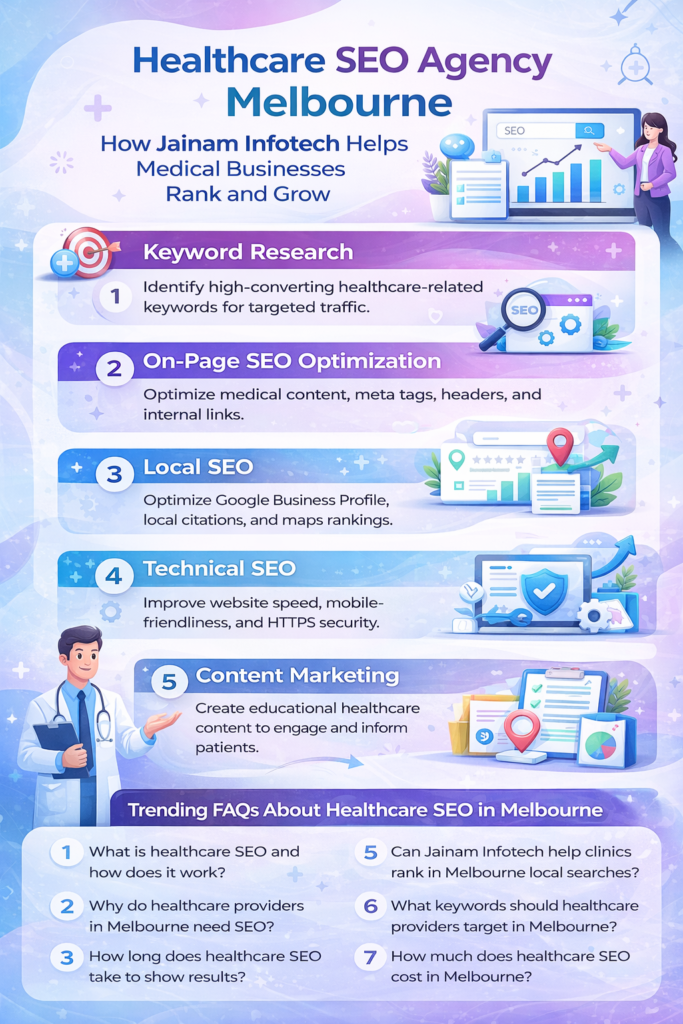
How Jainam Infotech Delivers Healthcare SEO Results
Jainam Infotech is a trusted digital marketing and SEO agency in Melbourne, offering tailored SEO solutions for healthcare businesses. Our approach combines data-driven strategies with industry expertise to ensure sustainable rankings and organic growth.
1. Keyword Research for Healthcare Services
We identify high-converting keywords such as:
- healthcare SEO agency Melbourne
- healthcare SEO marketing agency Melbourne
- medical SEO services Melbourne
- local healthcare SEO Melbourne
These keywords help healthcare providers attract patients searching for specific medical services.
2. On-Page SEO Optimization
Our on-page SEO strategies include:
- Optimizing page titles, meta descriptions, and headers
- Creating high-quality medical content
- Improving internal linking to service pages like https://jainaminfotech.com/services/seo-melbourne/
- Enhancing website structure and user experience
3. Local SEO for Clinics and Hospitals
Local SEO is crucial for healthcare providers in Melbourne. Jainam Infotech optimizes:
- Google Business Profile listings
- Local citations and directories
- Location-based keywords
- Maps rankings and local pack visibility
This helps clinics appear when patients search for healthcare services near them.
4. Technical SEO for Healthcare Websites
Healthcare websites must be fast, secure, and mobile-friendly. Our technical SEO services include:
- Website speed optimization
- Mobile responsiveness improvements
- HTTPS security and compliance
- Structured data for healthcare services
5. Content Marketing for Healthcare
Content plays a major role in healthcare SEO. Jainam Infotech creates:
- Educational blogs and articles
- Service-based landing pages
- Patient guides and FAQs
- Medical condition and treatment content
This builds trust and improves organic search visibility.
SEO Agency Melbourne: Why Healthcare Providers Choose Jainam Infotech
As a leading SEO agency Melbourne, Jainam Infotech focuses on delivering measurable ROI for healthcare businesses. Our team understands Melbourne’s competitive market and designs SEO campaigns tailored to healthcare providers.
Key benefits of working with Jainam Infotech include:
- Industry-specific SEO expertise
- Transparent reporting and analytics
- Ethical white-hat SEO strategies
- Proven track record in Melbourne SEO
- Customized SEO strategies for medical practices
How Healthcare SEO Drives Patient Growth
Healthcare SEO is not just about rankings; it is about attracting the right patients at the right time. When patients search for healthcare services online, appearing on the first page of Google significantly increases the chances of appointment bookings.
With targeted SEO strategies, healthcare providers can:
- Increase organic website traffic
- Generate qualified patient leads
- Improve brand awareness in Melbourne
- Reduce reliance on paid advertising
- Build long-term digital authority
Internal Linking Strategy for Healthcare SEO
For better SEO performance, healthcare blogs and tag pages should link to service pages. Jainam Infotech recommends linking to the main SEO service page to strengthen internal SEO signals:
SEO Melbourne Services Page:
https://jainaminfotech.com/services/seo-melbourne/
This improves page authority, keyword relevance, and user navigation.
Trending FAQs About Healthcare SEO in Melbourne
What is healthcare SEO and how does it work?
Healthcare SEO is the process of optimizing medical websites to rank higher in search engines. It involves keyword optimization, content creation, technical SEO, and local SEO to attract patients searching online.
Why do healthcare providers in Melbourne need SEO?
Most patients search online before choosing a healthcare provider. SEO helps clinics and hospitals appear in search results, increasing visibility, trust, and patient inquiries.
How long does healthcare SEO take to show results?
SEO is a long-term strategy. Initial results may appear within 3 to 6 months, while significant growth typically occurs within 6 to 12 months, depending on competition and strategy.
Is healthcare SEO different from regular SEO?
Yes, healthcare SEO requires industry-specific knowledge, compliance-friendly content, and local optimization strategies tailored to medical services.
Can Jainam Infotech help clinics rank in Melbourne local searches?
Yes, Jainam Infotech specializes in local SEO for Melbourne businesses, including healthcare providers, helping them rank in Google Maps and local search results.
What keywords should healthcare providers target in Melbourne?
Common keywords include:
- healthcare SEO agency Melbourne
- healthcare SEO marketing agency Melbourne
- medical SEO services Melbourne
- local healthcare SEO Melbourne
These keywords attract high-intent patients searching for medical services.
How much does healthcare SEO cost in Melbourne?
The cost varies depending on competition, services required, and campaign scope. Jainam Infotech offers customized SEO packages tailored to healthcare businesses.
Conclusion
Healthcare businesses in Melbourne must invest in SEO to stay competitive in the digital landscape. A specialized healthcare SEO agency Melbourne like Jainam Infotech provides targeted strategies to improve rankings, attract patients, and grow medical practices.
By combining keyword research, content marketing, local SEO, and technical optimization, Jainam Infotech ensures healthcare providers achieve sustainable online growth and increased patient acquisition.
If you want to improve your healthcare website’s visibility and generate more patient leads, explore Jainam Infotech’s professional SEO services in Melbourne and take your digital presence to the next level.
Usefull links: